
Scattered systems to a clear Integration plan
Manufacturing and Retail
In 4 weeks we mapped the company’s systems, clarified goals and reporting needs, and produced a practical integration roadmap. Leadership could see the big picture, brief developers with confidence, and move beyond manual workarounds.
Client Type / Sector
Irish manufacturer with D2C e-commerce & wholesale
Anonymity
Client name withheld
Timeline
4 weeks total: workshops, tool analysis, modelling, recommendations, edits/sign-off
Size / Footprint
Two physical stores, international online sales, national & international wholesale
Digital Maturity
Strong web presence; multiple unintegrated systems
Roles Involved
Co-owner, Operations lead
Engagement Route
Via national body (subcontracted)
Systems




Context & Challenge
Over 30+ years, the business had grown its product line and reputation, adding online sales, POS in two stores, and wholesale channels. But the core systems hadn’t kept pace.
Online orders were re-keyed into the POS, stock for manufactured goods lived in a warehouse notebook, there was no goods-in/out tracking, the MRP was only lightly used, and finance tools sat largely apart.
Leadership wanted to push into the next stage of online growth with better visibility and fewer manual handoffs.
The Approach
-
I ran focused workshops to understand the end-to-end flow -manufacturing, stock, retail, online, wholesale - and what leaders wanted to see in reports (inventory, sales by channel, lead times, margins).
-
Starting low-tech, I put every system, process, and data flow on individual sticky notes and arranged them physically to expose bottlenecks and re-entry points.
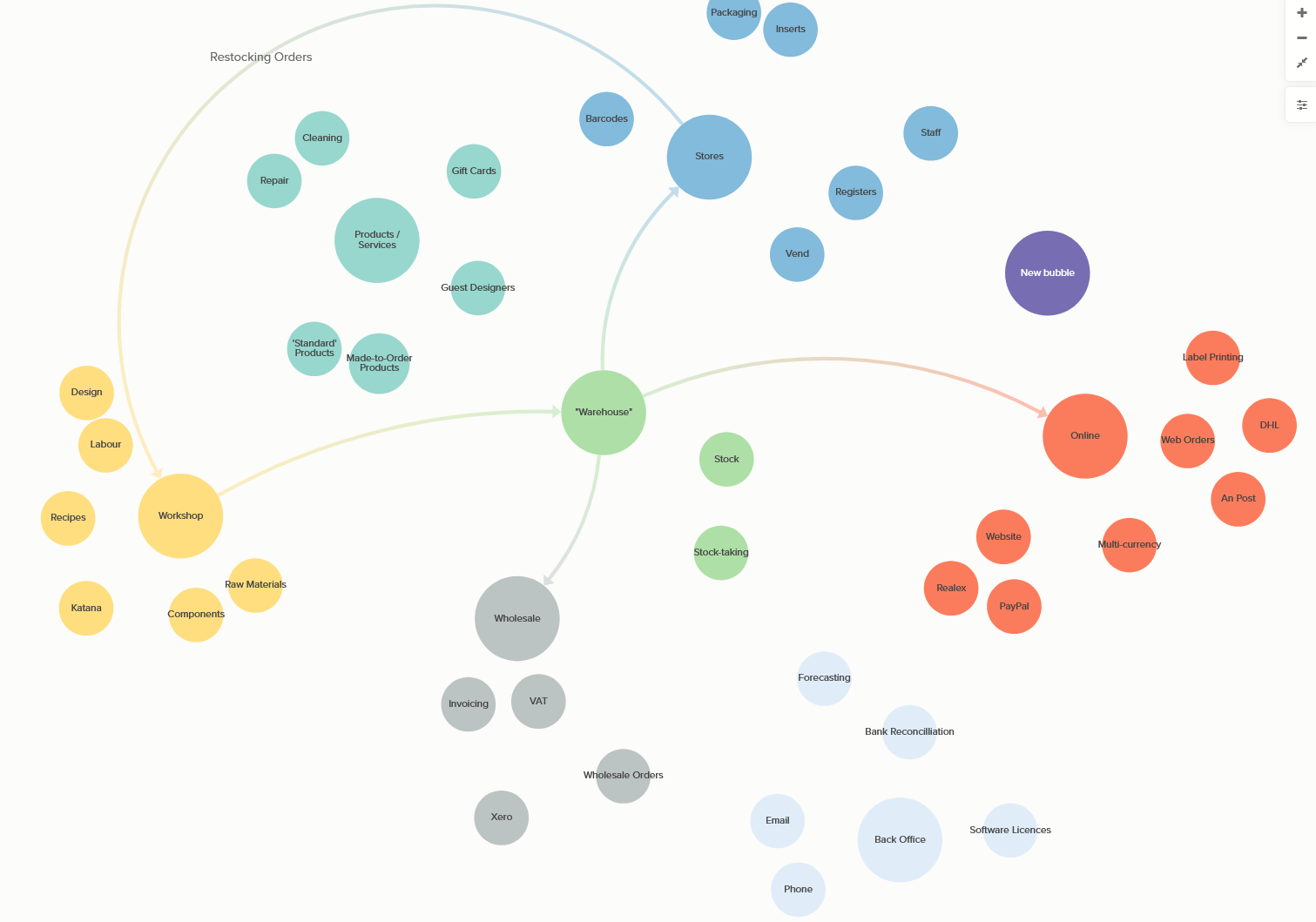
I then modelled the current state in kumu.io to visualise the ecosystem and data paths, and drafted a future-state map showing proposed integrations and ownership.
-
I analysed tool capabilities and integration options (POS ⇄ e-commerce, MRP ⇄ inventory, finance ⇄ sales channels), captured decisions, and compiled a practical next-steps document.
This included priorities, phasing, and developer-ready requirements to brief subcontractors.
Current-state system map (kumu.io) with data flows and manual touchpoints
Future-state integration diagram outlining proposed connections and responsibilities
Written recommendations with phased next steps, reporting requirements, and success criteria
Developer briefing pack to support hiring and onboarding subcontractors/web developers
deliverables
Outcomes
Clarity: Leadership gained a shared picture of how work and data actually moved, “seeing the wood, not just the trees.”
Decision readiness: A prioritised roadmap and concrete requirements gave them the “ammunition” to brief developers without ambiguity.
Transparency: Clear line of sight from manufacturing → stock → orders → finance, enabling meaningful reports.
Path to scale: Identified the quickest wins (e.g., reducing re-keying) and a pragmatic sequence for deeper integrations.
(Because implementation was to be completed by subcontractors, outcomes focus on organisational clarity and decision speed rather than post-integration metrics.)
"We finally understood how everything fits together, we could see how our data flows, and had a clear brief for our developers."
— Operations Manager

If your systems grew faster than your integrations, we can map what you have, choose what matters, and create a calm, phased plan that your team and developers can follow.